


Short answer: probably not yet.
ServiceNow AI is moving faster than most operating models can absorb it. The risk is not whether the AI works — it is whether your data, workflows, governance and adoption model are ready to produce value without creating cost, risk or operational noise.
This guide shows where each function stands today, why most enterprises are not yet ready, and how Crossfuze helps close the readiness gap before your renewal.
✓ Benchmark every function against a scored maturity curve
✓ Identify the four foundations that decide whether ServiceNow AI pays off
✓ Build the path from readiness gap to autonomous operations
THE BOTTOM LINE
ServiceNow AI including Otto is bundled into every tier from April 2026 — readiness is now a renewal-cycle decision. Clean data, documented workflows, AI governance and an operating model take 12–18 months to build. The teams that start now control the conversation.
THE BOTTOM LINE
ServiceNow AI including Otto is bundled into every tier from April 2026, readiness is now a renewal-cycle decision. Clean data, documented workflows, AI governance and an operating model take 12–18 months to build. The teams that start now control the conversation.
✓ A self-check: how ready are you, really, function by function
✓ The four foundations: data, workflows, governance, operating model
✓ Two pathways: Autonomous IT and Business Re-Invention (CBS)
Otto is more than a rebrand. Three things every IT leader should know before their next ServiceNow conversation.
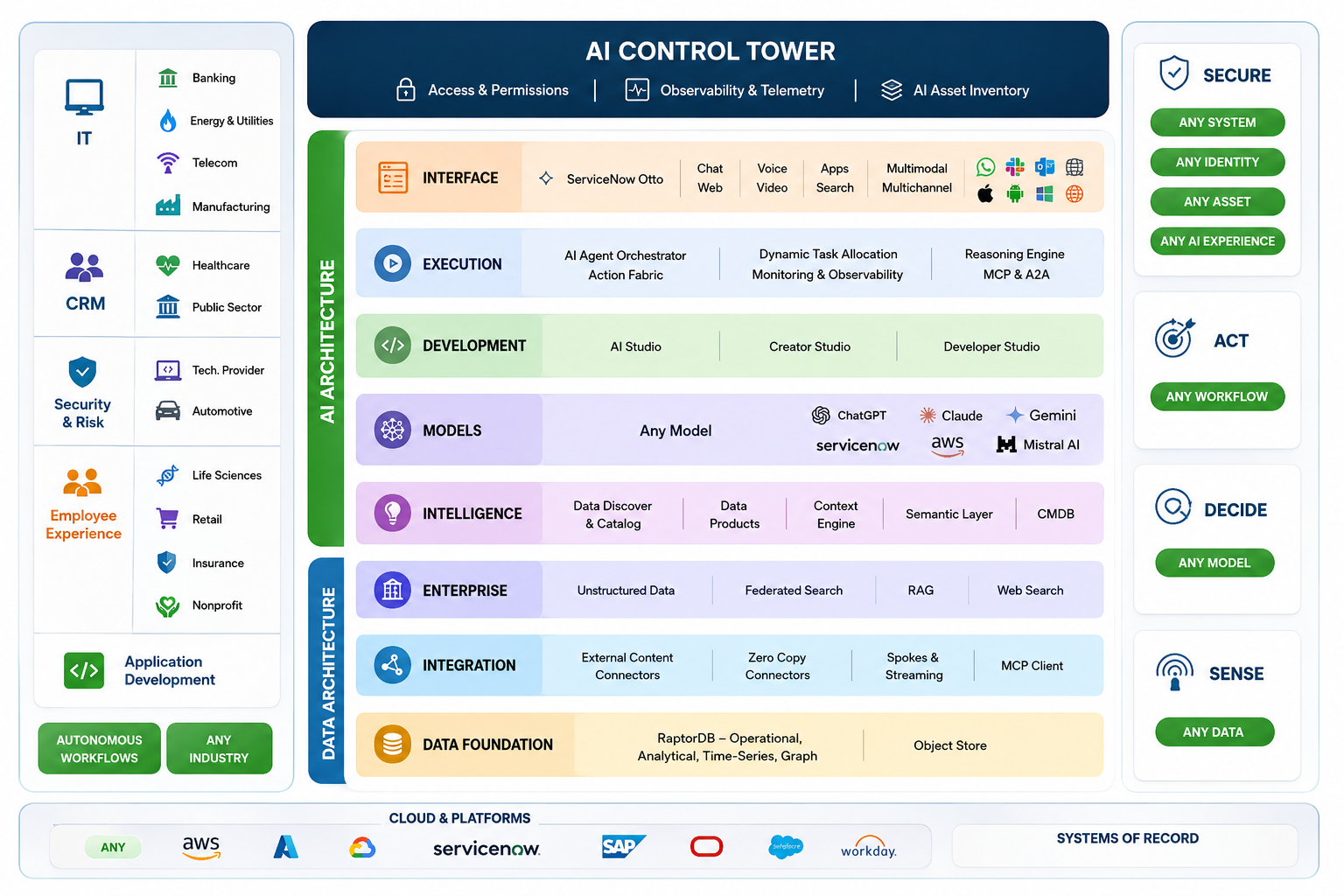
Now Assist, Moveworks and AI Experience now sit behind one conversational front door called Otto.
Conversational AI, Enterprise Search, AI Voice Agents & AI Data Explorer , all governed by AI Control Tower.
Whether you have 20 minutes or 2 minutes, each question below leads with the bottom line, then explains the detail.
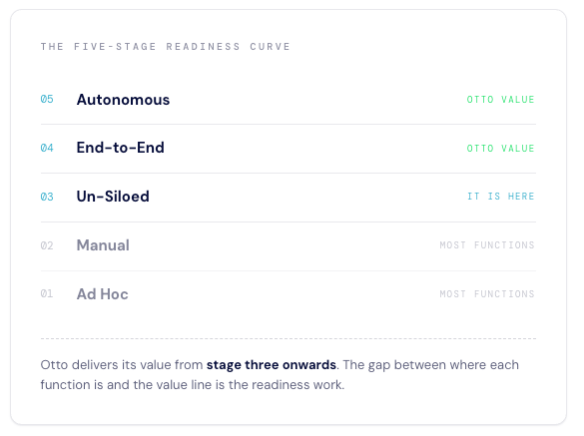
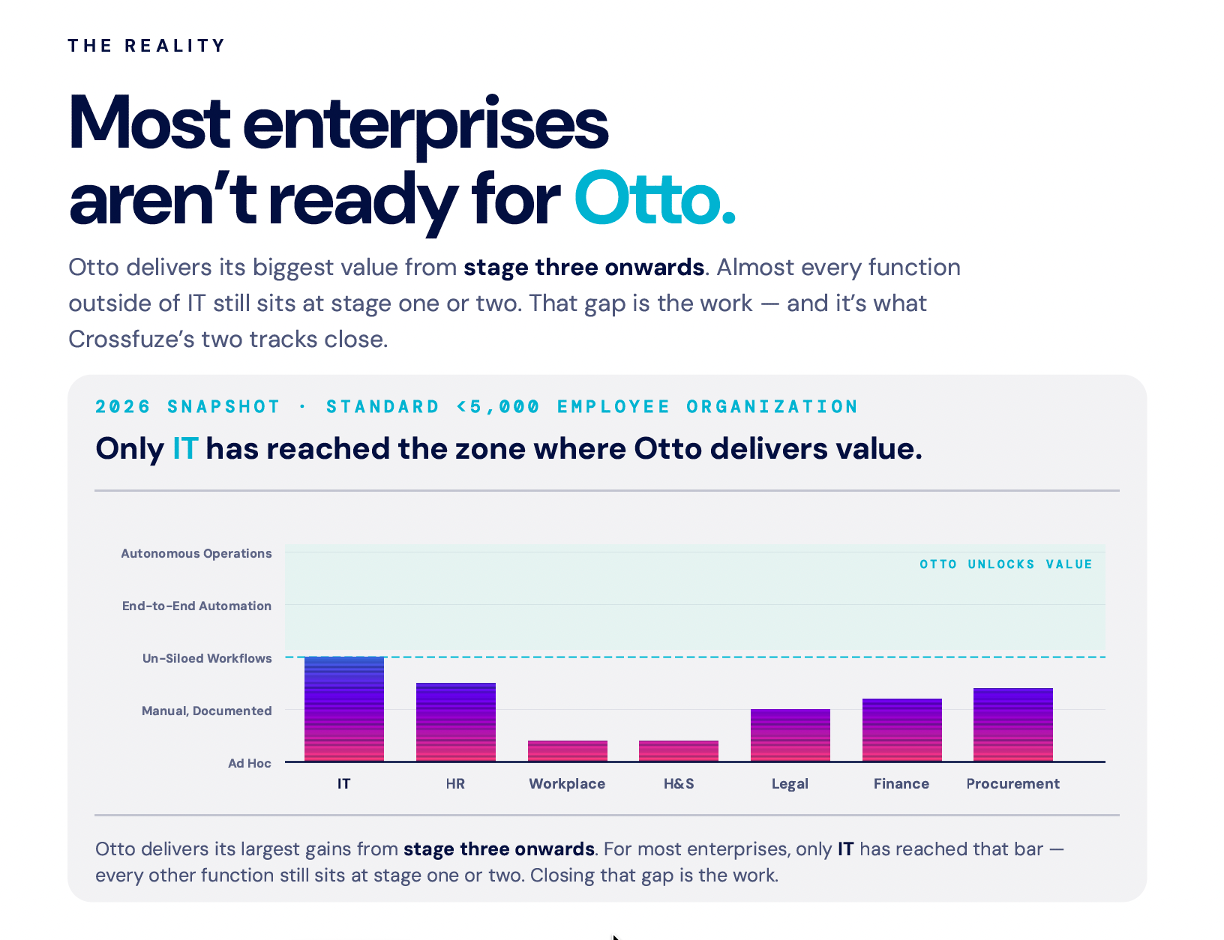
Most enterprises are not ready yet. Only IT has typically reached the maturity level where AI like Otto delivers value — HR, Finance, Legal and the rest usually still sit at Manual or Ad Hoc
Readiness is decided across four foundations: clean data, documented workflows, AI governance, and an operating model (a Center of Excellence). AI amplifies whatever sits beneath it — switch it on over messy data and ad-hoc process and you scale the mess.
Closing the gap typically takes 12–18 months. The organizations that win start the foundation work now, while running Now Assist today, rather than pausing AI investment to wait for Otto to land.
Why this matters:
Readiness is not one switch. The fastest way to know where you stand is to score every function against the five-stage maturity curve — which is exactly what the 90-minute assessment does.
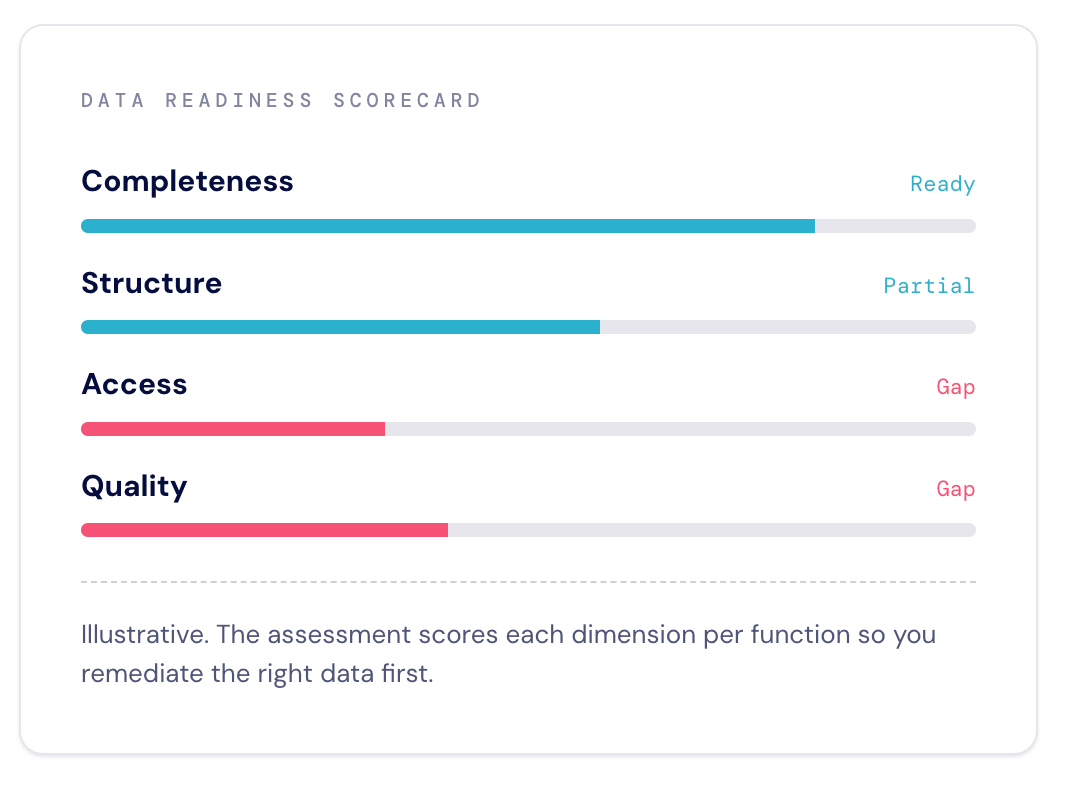
Score your data on four dimensions before any AI is switched on: completeness, structure, access and quality. AI amplifies whatever data it is given — poor data produces confident, wrong answers.
Completeness — are records populated and current?
Structure — consistent fields, taxonomies and CMDB integrity?
Access — can agents reach the data through governed connectors?
Quality — deduplicated, accurate, trustworthy?The practical first step is a function-by-function data and workflow audit. It tells you which data is ready to feed an agent today and which needs remediation first.
The practical first step is a function-by-function data and workflow audit. It tells you which data is ready to feed an agent today and which needs remediation first.
Why this matters:
Data is the single biggest predictor of AI success — and the most commonly skipped step. Foundation work done now compounds, no matter how the ServiceNow brand evolves.
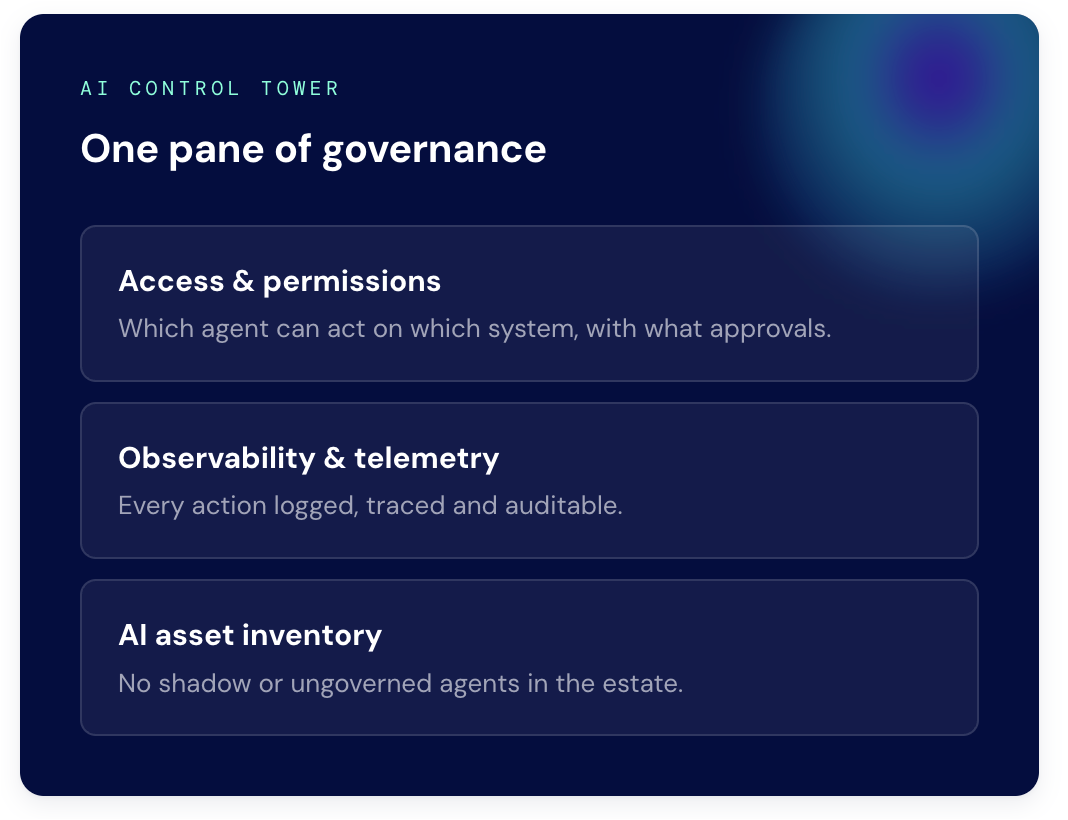
Through AI Control Tower — the platform's single pane for access and permissions, observability and telemetry, and an inventory of every AI asset in your estate.
Tooling alone is not governance. Pair AI Control Tower with policy: define which agents can act, on which systems, with what approvals, and ensure every action is logged and auditable.Critically, governance is set up before agents are given the ability to complete work — not retrofitted after something goes wrong..
Why this matters:
Autonomous agents act on real systems. Without governance you get shadow agents, no audit trail and unbounded cost against the metered assist pool. With it, you scale automation safely.
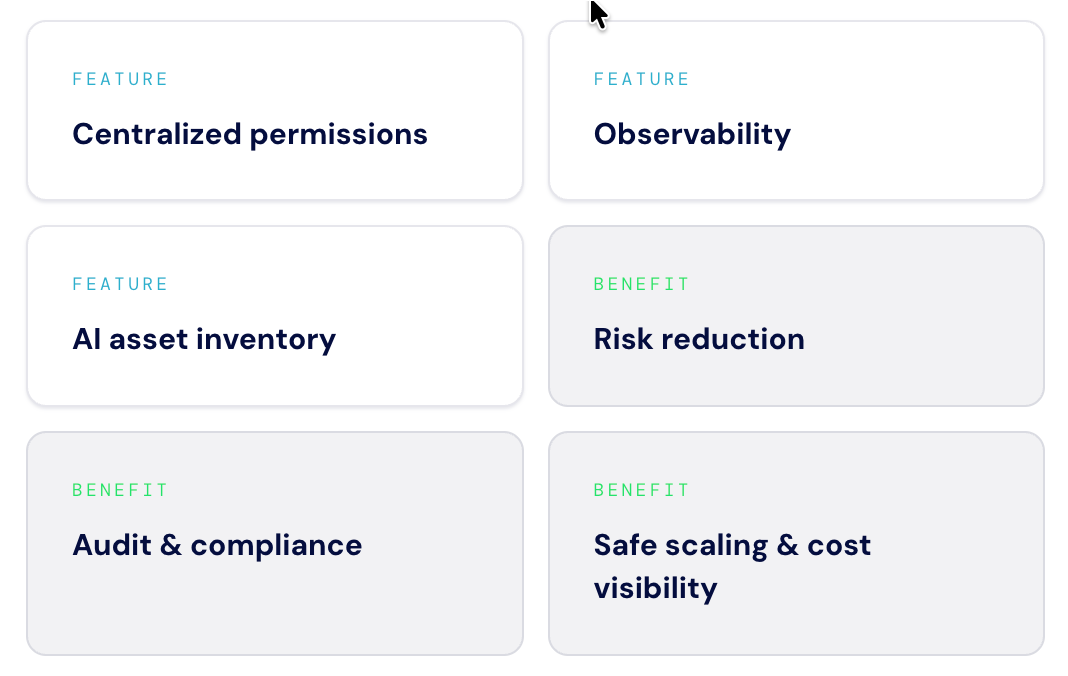
Three features — centralized permissions, observability, and a full AI asset inventory. Four benefits: risk reduction, auditability, safe scaling, clear cost and usage visibility.
Governance turns autonomous AI from a liability into a controllable, scalable capability. It removes shadow agents, satisfies compliance, lets you expand automation without fear, and keeps spend visible against the metered assist pool.
Why this matters:
The biggest commercial risk is not the headline licence tier — it is ungoverned AI usage scaling silently. Governance is what makes the business case for autonomous AI defensible to a CFOs.

The best partners assess your data, workflows and governance before recommending tooling, and map a clear path from where each function is today to where AI pays off — no handoffs to junior consultants.
Crossfuze is a ServiceNow Elite Partner specializing in AI readiness and autonomous-enterprise transformation, with white-glove delivery across IT, HR, Finance and the wider CBS estate.

Otto is the unified AI frontdoor to ServiceNow — not a rebrand, a structural shift. Three products now sitbehind one conversational interface that completes work end-to-end, not justanswers questions.
ServiceNow built or acquired three AI products that now sit behind oneinterface: Moveworks (acquired December2025) as the conversational front door across 100+ systems; Now Assist for GenAIsummarization, drafting and search in the flow of work; and AI Agents for agentic executionof governed workflows through Action Fabric.
Otto is not a separate SKU. From April 2026, these components are bundled intoevery
Foundation, Advanced and Prime tier. AI consumption is metered against a per-seat assist pool — which iswhy readiness is directly cost control.
Why this matters:
Your renewal conversation has already changed. The headline tier is no longer the risk — ungoverned AI usage exhausting the assist pool silently is. Readiness is what keeps the cost predictable.
Otto is live today inside two products only: ServiceNow EmployeeWorks and AI Control Tower. ServiceNow has committed to rolling Otto out across the rest of its product portfolio during 2026, via the Australia release and subsequent platform updates.
Now Assist remains the GA product for AI deployments today. Otto is the architectural direction. Practitioners should build on Now Assist with the understanding that the experience layer will evolve toward Otto — not pause AI investment waiting for Otto to land.
Why this matters:
The foundation work for Otto: clean data, documented workflows, AI governance, a Center of Excellence — typically takes 12 to 18 months. Customers who start now will be ready when Otto reaches HR, Finance, Legal and the rest of CBS in 2026.
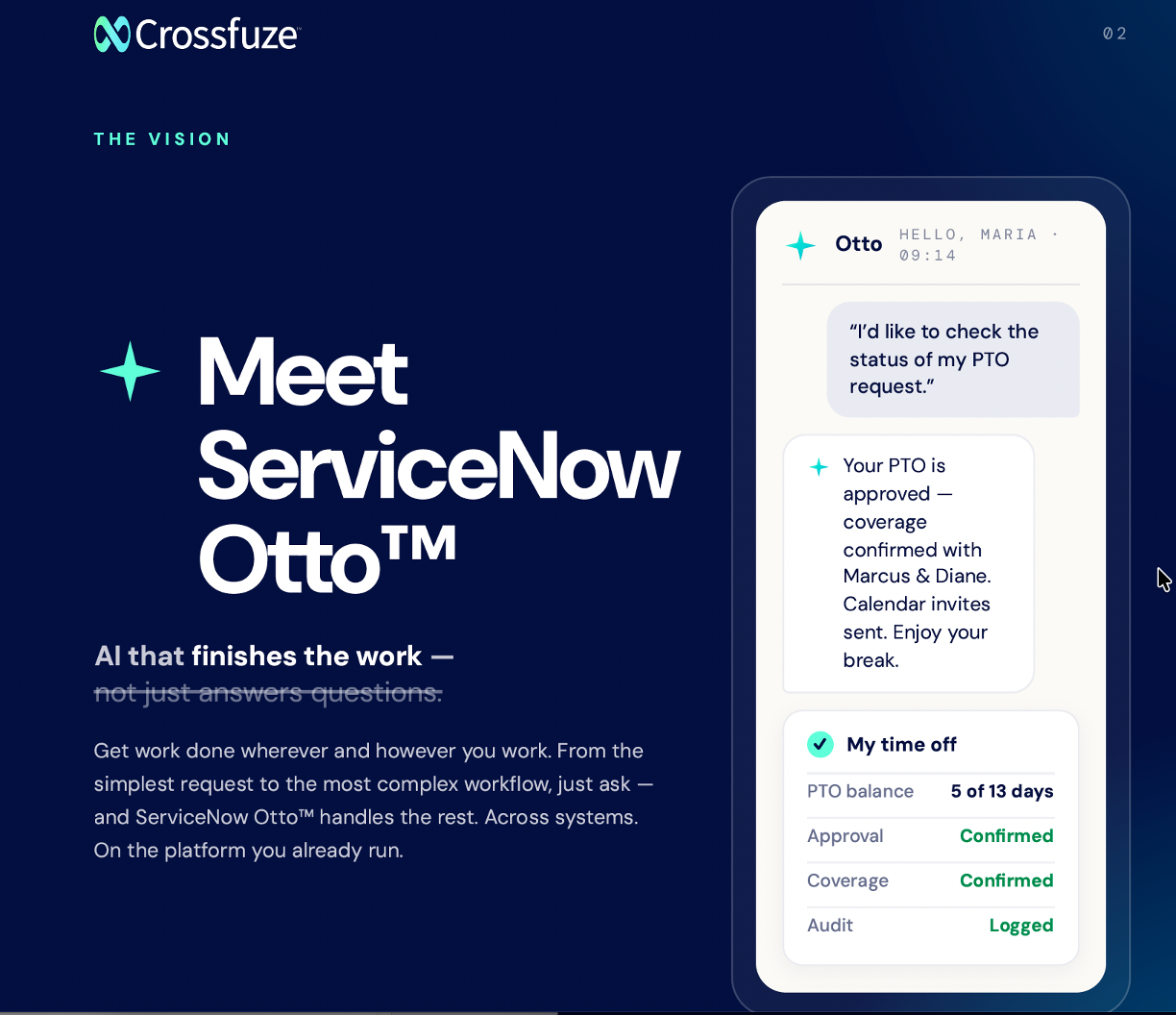
Otto is the unified experience layer. Now Assist is the underlying generative AI capability, summarisation, drafting, in-flow assists. Moveworks is the conversational AI front-end ServiceNow acquired in December 2025, with native integrations into over 100 enterprise systems.
Otto sits on top of both, picking the right AI agent or workflow and executing it across systems. Four layers underneath: Experience (Otto), Capability (Now Assist), Execution (Now Platform), Governance (AI Control Tower)
● Why this matters:
Now Assist is what you deploy today. Otto is what employees will eventually experience. The architecture beneath both is the same, which is why platform readiness work done now compounds, regardless of how the brand evolves.
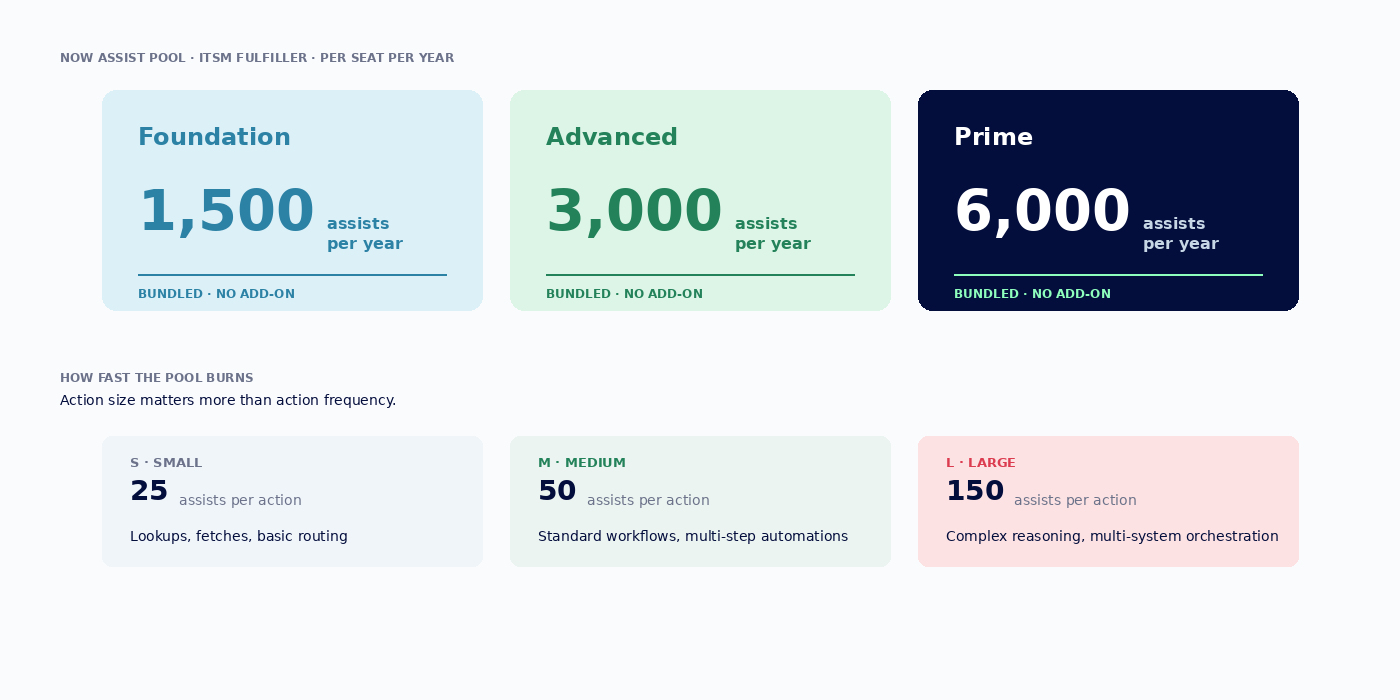
Otto is not sold as a separate SKU. Following ServiceNow's April 9, 2026 commercial model change, Otto's underlying components — Now Assist, Moveworks, AI Control Tower, Workflow Data Fabric and Virtual Agent — are bundled into every Foundation, Advanced and Prime tier rather than sold as add-ons.
AI consumption is metered against a per-seat assist pool. When that pool is exhausted, top-up charges apply at a per-unit rate. The top-up rate is negotiable at renewal but not after.
Legacy AI SKUs may still appear on renewal drafts as separate line items and should be removed before signature.
● Why this matters:
The biggest commercial risk is not the headline tier. It is what happens when AI usage scales and the assist pool exhausts. See our companion guide for tier mapping, pool sizes by product, and the three commercial controls every CFO should secure before signing
Competing AI assistants sit inside a single vendor's application. Microsoft Copilot inside Microsoft 365. SAP Joule inside SAP. Salesforce Agentforce inside Salesforce. Each is excellent at completing work within its own walls.
ServiceNow Otto sits across the enterprise. It connects to over 100 enterprise systems through the Moveworks layer and executes work that spans multiple systems, approval chains and departments.
ServiceNow's framing: other AI assistants answer questions in one application; Otto completes work across all of them. ServiceNow calls this the completion problem.
Procurement action: The question is not "Otto vs Copilot." Most enterprises will run both. The question is which AI completes work the user actually needs done. For cross-system work — HR onboarding, IT incident resolution, procurement intake, employee lifecycle — the right AI is the one connected to every system involved.
Author: Jeslyn Carlson, VP, Growth & Market Strategy · Crossfuze
Crossfuze is a ServiceNow Elite Partner and the 2025 ServiceNow Elite Consulting & Implementation Partner of the Year. Our team holds 12 ServiceNow Product Line Achievements and has supported renewal modelling across legal, financial services, technology, and higher education organisations.
This guide reflects our analysis of ServiceNow Otto, published on 3rd June 2026, combined with direct experience preparing clients for the new AI experiance.
Last updated: 3rd June 2026


.png)
.png)
