





At some point in the next two quarters, someone senior is going to ask you a direct question.
Not whether the organisation is investing in AI. That much is already settled and visible in the budget.
The question will be whether the organisation is ready to use what it has bought, in which functions, to what standard and at what running cost.
The uncomfortable part is that this question tends to arrive at the worst possible moment.
It arrives in a board pack, three weeks before a renewal, or in the middle of a business case someone else has already written.
It arrives when the answer needs to be immediate, evidenced and specific—and when there is no time left to go and find out.
That is the moment worth preparing for.
Not simply the AI strategy. The question about it.
The readiness gap most leaders discover too late
ServiceNow’s Enterprise AI Maturity Index 2026 puts a number on the distance most organisations are carrying.
Fifty-nine percent of organisations have progressed beyond agentic AI pilots. Only 9% report meaningful progress towards autonomous, multistep workflows.
That is a 50-percentage-point execution gap between progressing beyond experimentation and achieving trusted, autonomous work.
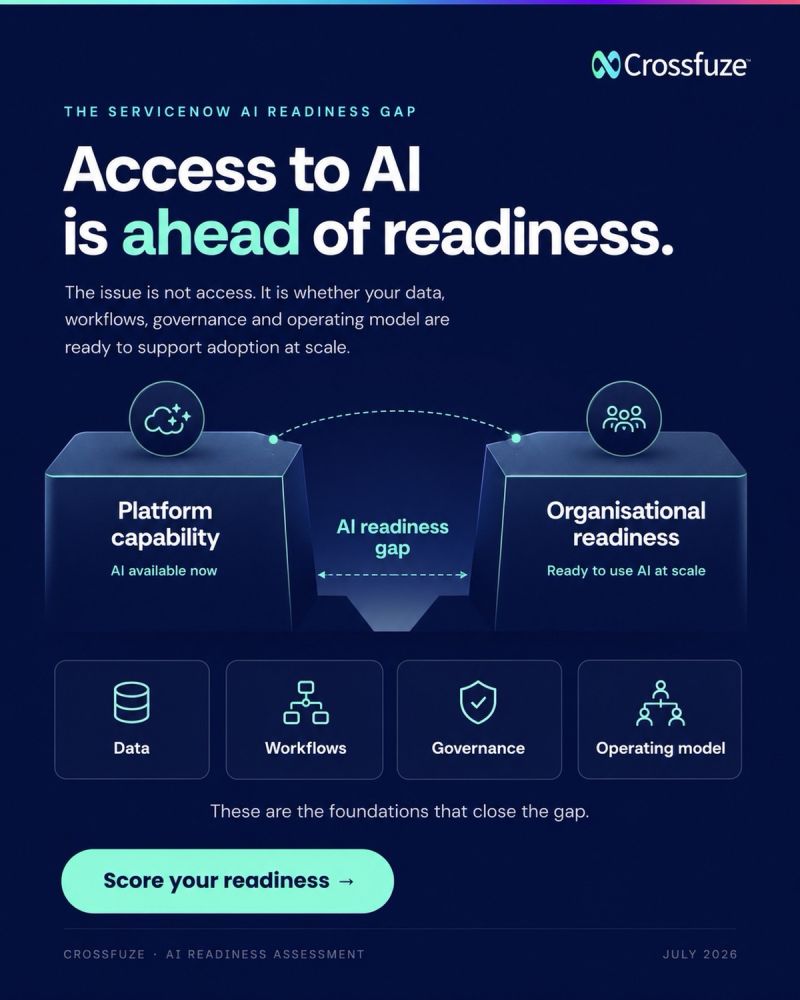
This is the ServiceNow AI Readiness Gap: the distance between the AI capability already available in your platform and your organisation’s ability to deploy, govern and scale it into trusted, end-to-end work.
It is not a gap in ambition.
UK AI spending increased by 102% in a single year, according to the same research, while the UK achieved an overall AI maturity score of only 51 out of 100.
Investment is moving faster than the data, workflows, governance and operating models required to convert it into measurable outcomes.
The gap is not primarily a technology problem.
It is the thing that catches leaders out.
Availability is not readiness
An organisation can have generative AI, virtual agents and automation licensed and available across its technology estate while still relying on:
- incomplete or duplicated records;
- inconsistent process routes;
- outdated knowledge articles;
- undefined approval rights;
- disconnected systems;
- manual handoffs between departments;
- limited visibility of AI usage and cost;
- no agreed controls over what an AI agent may access or change.
The technology is present.
The operating environment underneath it is not ready to support it.
In that state, AI can still perform. It can summarise information, draft responses and answer questions.
What it cannot reliably do is complete trusted work across the enterprise.
An agent can only act on the data it can reach, the process it can interpret and the permissions it has been given.
Where those foundations are incomplete, AI does not remove operational complexity. It accelerates and amplifies it.
The ServiceNow research shows where those foundations remain weakest among UK organisations:
- 73% identified inadequate data accuracy, access and management as a barrier to AI adoption.
- Only 20% had implemented AI testing, auditing and risk-assessment processes.
- Just 17% had replaced fragmented legacy systems with integrated platforms.
- Only 15% had streamlined or integrated workflows using AI.
- Approximately two-thirds had experimented with agentic AI, but only 6% were using it to create autonomous workflows.
That distinction matters more with every step from copilots that assist people towards agents that act on their behalf.
The mistake is scoring the enterprise as one number
Most readiness conversations produce a single organisational verdict:
Ready or not ready.
That verdict is almost always incomplete because readiness is not distributed evenly across the enterprise.
IT may already have documented processes, structured records, a maintained CMDB and clear ownership. It may be genuinely ready to expand Now Assist across established service-management workflows.
Finance may still depend on manual reconciliation and spreadsheet-based approvals.
HR may have mature employee case management but fragmented knowledge.
Procurement may have structured intake but inconsistent supplier data.
Legal may have strong controls but limited workflow automation.
Apply the same AI capability across each function and you will not achieve the same outcome.
In the less mature function, an agent encounters poor data, inconsistent workflows and unclear decision rights. Rather than creating autonomy, it can route people into the same operational dead ends faster than before.
Assessing readiness function by function changes what you can do with the answer.
Instead of attempting to enable AI everywhere at once, you can identify:
- where AI can deliver measurable value now;
- where limited remediation is required first;
- where foundational transformation must happen before adoption;
- which use cases should wait until the operating environment is ready.
That is not a brake on adoption.
It is how investment gets directed towards the areas most capable of returning it.
What readiness is actually made of
Four foundations determine whether a business function is ready.
They provide the evidence behind the maturity score.
Data
Records need to be complete, current, consistent and governed.
Duplicates and obsolete entries must be addressed, taxonomies aligned, knowledge content maintained, configuration and asset information trustworthy, and agent access managed through governed connections.
Poor data rarely announces itself with an obvious system error.
It can produce a confident, authoritative-looking but incorrect answer or action.
That is why data readiness remains one of the most important—and most underestimated—components of enterprise AI adoption.
Workflows
Value comes from completing work, not merely producing answers.
That requires documented, repeatable processes with clear decision points, ownership, approvals, service levels and exception routes.
Before automating a workflow, organisations need honest answers to several questions:
- Is the process documented?
- Is it followed consistently?
- Are responsibilities and approval rights clear?
- Can exceptions be identified and routed correctly?
- Does the process cross multiple systems or departments?
- Should the workflow be redesigned before it is automated?
Automating a broken process does not reinvent the work.
It makes the existing problem happen faster and potentially at greater scale.
Governance
As AI moves from recommending actions to completing them, governance stops being a policy exercise and becomes part of the architecture.
Organisations need defined answers to:
- Which agents are permitted to act?
- Which systems and data may each agent access?
- Which actions require human approval?
- How will decisions and actions be recorded?
- How will performance, risk and consumption be monitored?
- Who is accountable when an automated decision produces an unexpected outcome?
ServiceNow AI Control Tower can provide an important technology layer for permissions, observability and AI asset management.
However, tooling alone is not governance.
It requires policies, ownership and defined decision rights behind it.
Retrofitting these controls after autonomous agents are already live is the more expensive and higher-risk route.
Operating model and adoption
Someone must decide how AI opportunities are selected, funded, delivered and measured.
That requires coordination across:
- ServiceNow platform ownership;
- enterprise architecture;
- data and security;
- risk and compliance;
- procurement and finance;
- HR and change management;
- business-function leadership.
Without this shared operating structure, individual teams can deploy disconnected agents without a consistent view of business value, risk or cost.
Employees also need to understand how their roles will change, when AI should be trusted and where human judgement must still apply.
Training people to use an interface is not the same as preparing them to work within an AI-enabled operating model.
The agentic cost paradox
There is a second reason this has become urgent.
It is commercial.
The more successfully an organisation scales AI, the more consumption it generates.
Without an adoption and consumption model, greater business value can also create faster and less predictable cost growth.
This is the agentic cost paradox.
Organisations may discover the scale of their expected consumption late in the renewal cycle, when negotiating leverage is already reduced.
You cannot resolve this by comparing licence features alone.
It requires a view of:
- which workflows will use AI;
- how frequently different user populations will trigger AI activity;
- which functions are ready to generate value;
- where adoption is likely to grow;
- whether expected consumption aligns with available entitlement;
- how that consumption will affect the next renewal.
The risk is not simply choosing an unsuitable tier.
It is arriving at renewal without a credible model of how AI will be used, what value it should create and how much consumption that adoption could generate.
Five questions worth answering before the board asks
1. Which functions are genuinely ready today?
Readiness should be evidenced through data quality, workflow maturity, ownership and governance—not assumed because a product is available.
2. Which workflows should go first?
The strongest initial opportunities are usually high-volume, repeatable workflows with clear decisions, reliable data and measurable outcomes.
3. What must be fixed before autonomous agents are introduced?
This may include knowledge quality, CMDB integrity, process documentation, integration gaps, approval rights or inconsistent data structures.
4. How will AI activity be governed?
The organisation needs visibility of agents, permissions, actions, outcomes, risks and consumption.
5. How will adoption affect the next renewal?
Expected usage, entitlement and commercial exposure should be modelled before commitments are signed—not after adoption begins to scale.
When those five questions have evidenced answers, the board conversation holds far less risk.
When they do not, it is only a matter of when the gap becomes visible.
Walk into the conversation already holding the answer
Crossfuze’s complimentary 90-minute ServiceNow AI Readiness Assessment brings together two connected views.
Operational readiness
A scored maturity benchmark across six business functions, identifying where AI can create value now, where remediation is required and what should be prioritised over the next 90 days.
Commercial readiness
A Renewal Cost Modeller that maps planned adoption against Foundation, Advanced or Prime and forecasts expected Now Assist consumption and exposure.
You leave with:
- a maturity score across the assessed business functions;
- an indicative tier and entitlement recommendation;
- a forecast of expected Now Assist consumption;
- a prioritised 90-day readiness and adoption plan.
The investment decision has already been made in most organisations.
The question is whether the organisation underneath it is ready.
Book your complimentary 90-minute ServiceNow AI Readiness Assessment.
Prefer to explore the framework first?
Download The ServiceNow AI Readiness Gap: A Practical Guide.


.png)




.svg)


.png)
.png)
